

Working it out
Because problem-solving is my middle name

PS problem-solving IS NOT my middle name. That would be Jane, like 33% of the female population from the 1970s.
Last week in the Lighten Up membership for dog folk, we were talking about attachment theory. This always crosses over into notions of independence and identity. Ironically, I was also thinking a lot about the 1970s and my parenting.
Don’t get me wrong: I love my parents.
But when we were discussing John Bowlby’s attachment theory in university in the early 1990s, I was all:
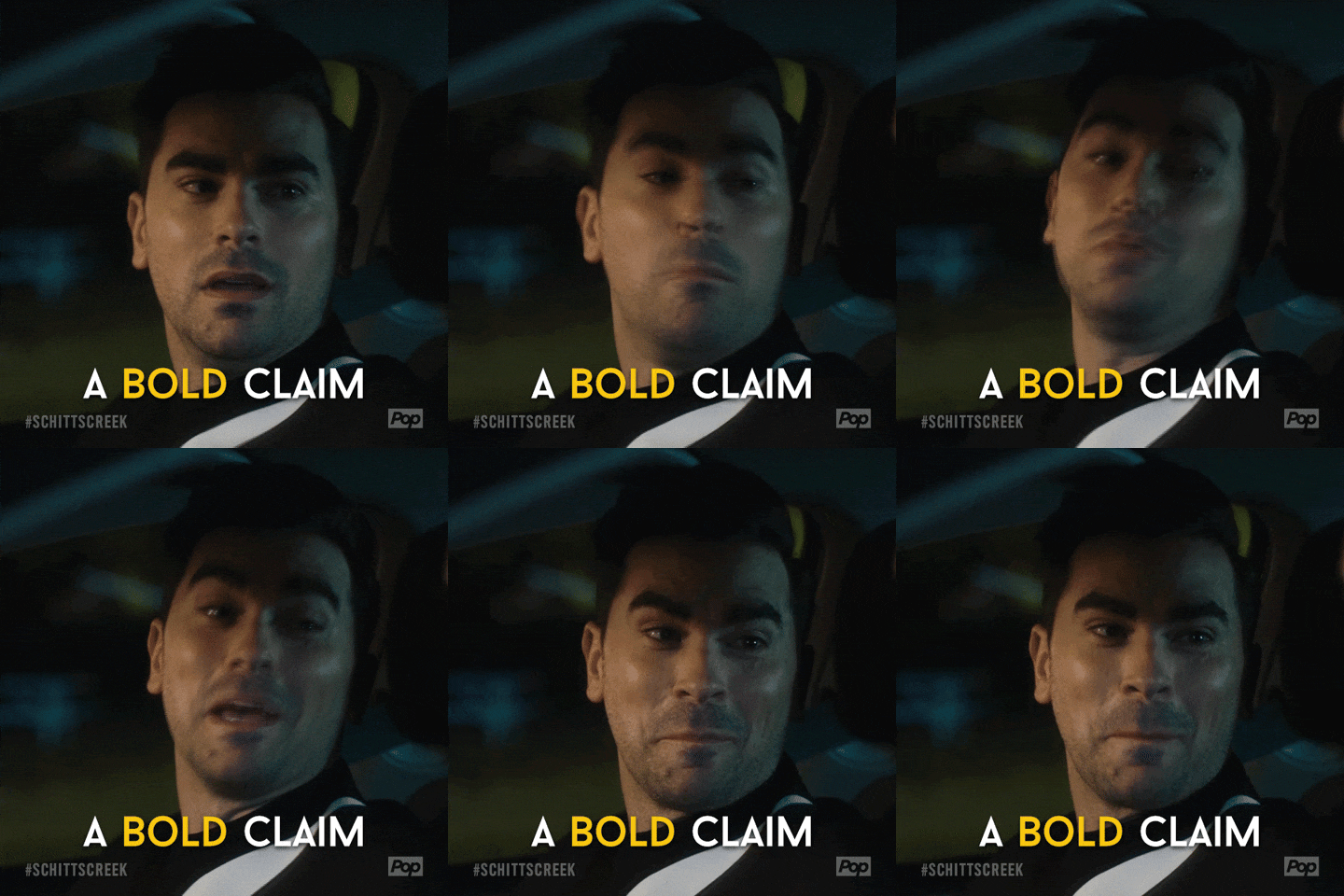
First off, I’d done a first year module on Marx. Second, I’d done a first year module on feminism. 20-year-old me really thought she knew it all. All I saw was a really neat way to enforce the patriarchy and to damn mothers.
It came up from time to time in teaching A level Psychology, when I sprinted through it as quickly as possible, pinpointing the ways it made me feel all cynical. And when I came to it in the dog world suggesting our dogs also have attachment styles, I was more than a little concerned.
But I would be.
I’m a child of the 1970s. We practically raised ourselves. What do they call Gen X? The generation who drank from the hosepipe if they got thirsty?
We didn’t even live in a realm inhabited by parents. We went to school. I walked myself the mile to school, by the way, from age six. That involved a lane where flashers regularly hung out (wish I was even kidding) and walking along a half-mile stretch of main road at a time when seat belts weren’t even mandatory. I also supervised other children along this walk, including kids who were regularly subjected to racist remarks by an uncouth boy from a school we had to walk past. Our instructions were not to walk down the lane where the flashers were. We were more scared of our parents’ wrath if we were found out than we were scared of the flashers, to be honest.
This is not a humble brag. It’s just how parents parented in those days and how kids got along. They talk about parentified children, and that just about describes us. I was making breakfast and hot drinks aged seven. When the boy from the neighbouring school and I got into it over a nasty name he’d called my friend and said bully pulled the buttons off my cardigan, then my dad went round to tell his dad whatever dads told other dads whose sons were fledgling sexists, ableists, racists and bullies. It was never the end of it with the aforementioned bully, but he learned to bow to my superior tool usage when I tied a scarf too tight around his head and he nearly passed out. He might have been bigger but I was smarter.
So all this came out in our chats about attachment.
No wonder when our divine and earthly developmental psychology professor was teaching us about attachment theory did I pooh-pooh the whole notion.
Secure attachment?!
Christ.
Most people I knew raised in the 1970s were feisty and independent, growing up outside the sphere of parents. I think I spent dinner time in the presence of my mother, and then we were out on the street with other children. If it got rowdy, some neighbour would step out and yell at us all, threaten our footballs with a carving knife and we’d all crap ourselves in case they told our parents.
We got good at problem solving. Some wag had left a bunch of paving stones at the bottom of our road, and we invented levers and fulcrums to move them. We took to magic for a summer, grinding stones up into ‘power’. We were imaginative, wild and inventive blessed with little other than a long piece of elastic (great for skipping games) and about two working bikes and a plastic sledge between ten of us.
Needless to say, whenever I do any attachment style surveys, I usually come out as something psychopath-adjacent that also reads strangely akin to people’s descriptions of Sagittarians. Now since I view star signs with fondness but also a complete and utter lack of regard, reading that we are aloof, strangely phobic of commitments, highly independent individuals with a penchant for vagabondage and itinerancy, is this a) because I’m a Sagittarian b) because I have a dismissive-avoidant attachment style c) because I was raised in the 1970s and it’s just how parents raised kids in those days?
Plus, is it really a problem?! I like to think I have attachments. I have friends. My siblings and I are as thick as thieves. I have zero boundaries with my dog Lidy (especially last night when I realised that the foul smell on my pillow emanated from her backside) and I miss my grandparents like crazy. You can’t have shepherds if you have dismissive-avoidant insecure attachments. You simply can’t. If there’s a clingy-as-eff zodiac sign, most shepherds are born under it. We’re their flock. End of. Lidy runs in a circle around me every single morning just to habituate me to the fact that I’m her family and it’s her job to keep everyone else out of that circle.
We Gen Xers with our insecure attachments can often be labelled as hyper-independent. According to TikTok, this is a trauma response because you had nobody to rely on. Or it’s a sign of insecure attachments. Or a sign we’re Sagittarians. Or Pisces. Or it’s a sign of some neurodivergent personality. Or we’re just cold fish.
20-year-old me likes to ask if these things would be seen as problematic if they are terms applied to men. Would a man be labelled hyper-independent? Or would he just be Bear Grylls? You’re a good boy scout if you can light a fire, clean the glass with its cinders, cook up a stew, make a tent out of branches and a piece of tarpaulin.
Do these things if you’re a woman and people are pathologising you. Heaven help you if you are independent minded and you have kids. You’ll have RFK Junior blaming you for every way in which they deviate from whatever norm they’ve decided as normal.
But isn’t problem solving what it’s all about?
One of the tests for canine independence is from the Duke University project. I did it back in the day with Heston and Tilly. You got a piece of hot dog and put it in a sealable box. Then you gave that box to your dog and watched them. However long they stuck at it told you about their independence. Yes, you also might know this as the ‘impossible task’ used to assess perseverence and frustration, by the way.
Heston didn’t look at me once. Then he gave up and went to bark at something outside. Tilly pawed the tupperware once, stopped and looked up at me.
Was this their sign?
Was Heston insecurely attached to me? Was Tilly too attached to me?
Tilly once tried to get a stuck treat out of a food puzzle for two and a half hours, by the way. I was working and couldn’t intervene. All I could hear was her batting around a Kong Wobbler for 210 minutes without quitting.
Heston used to put himself to bed or take himself outdoors if I started teaching. If I stopped and went to bed, he’d go and sleep in the living room.
Rude much?!
The problem with all of these is in the pathologising of behaviour. The reduction of behaviour to a label deemed good or bad. The creation of explanatory fictions and labels that don’t account for traits, for individuality, for identity, for lifestage, for learning history.
A lovely colleague and I got talking about this, too: the reduction of things to a simple test. Now, as a mid-person on the exam pecking order partly in charge with overseeing the quality of marking for 600000 GCSE papers every summer, I know a lot about simple tests. Back in the day, one of the very, very bigwig people and I ended up sharing a lunch table together and talking about assessment tasks we were planning to introduce to gauge progress. Bear in mind that said bigwig was the chief advisor to the government about tests at the time.
“Emma,” he said to me. “We should never forget that all a test does is sample singular, measurable skills on a single given day. It tests nothing other than a singular slice of a tiny part of what makes that individual.”
How right he was.
He asked me if we could measure love of Shakespeare, appreciation of language, the writing skills of James Joyce or Cormac McCarthy or Angela Carter or Toni Morrison or the ability to write a bloody good football chant that everyone ends up singing for the next sixty years.
As conversations go, it was one of the eye-opening ones for me. A young upstart from the dark and hilly counties thinks she’s got something to say, and the wise old owl reminds her that there is more to life than is dreamed of in her philosophy.
All this to say that it’s very hard to assess problem-solving skills or how good a group of children are at creating levers and fulcrums to move paving stones. It’s very hard to create tests that assess how good children (and adults) are at solving complex social problems.
And even if you can assess it, what does it mean?
What does it tell us?
Well, as my owlish guru would perhaps have said, it tells us only about a tiny slice of an individual at a singular moment in time. He’d also tell us that the knowledge we glean from it is decontextualised and meaningless. Skills, he’d tell me, could only be understood in the context.
There are always strong movements towards pathologisation from some quarters of the world who research canine behaviour. I like to think it is our job to resist that temptation as much as possible. Labels and psychological pathologies are always a product of culture. One cultures’s hyper-independent and troublesome Gen X woman with her dismissive-avoidant attachment styles is another culture’s wise woman who always knows where the best berries and mushrooms are to be found in the forest and who’ll recommend a weekend away in some remote outpost, even some alternate dimension.
“But how will we get there?” you might ask.
“Who knows?! But I’m sure we’ll figure it out!”
The same is absolutely true for our dogs.
Keeping our eye on the fact that there is more than a singular label and that labels are always dependent on context is such an important rule in a modern world that seeks to reduce us to a pathology.
Faithfully yours,
A Sagittarian Gen-Xer who doesn’t care for labels.