

Endless variations on a theme
Finding order

That horse I’m sitting under is starting to make me sweat a little for liberation. Currently, I’ve 38 sessions still to record for the Fear course. 11 of those are case studies. 18 focus on safety and inhibitory processes. The rest are the sundry approaches that lie in more traditional approaches. I reckon it’ll take me until early March to get the final ones recorded, since I’ve got a month of exam review marking to complete in January. I should hopefully get the final session uploaded before the final module goes live on the first Monday of April.
Then, I’m hoping to have a few months of themed posts that help people out. That’s what’s making me sweat for liberation.
There was some chat on my Facebook page about dogs who bark AT you rather than barking at stuff outside the home, so I pulled together some quick thoughts on the process for reducing that behaviour. I was reminded of a client from a couple of years back whose dog barked at her throughout any zoom calls she had when she was working from home. So often in dog literature, that’s treated as a nuisance behaviour, isn’t it? It’s really annoying too, because it works. To say nothing of the fact that we’ve bred a bunch of dogs who use barking a lot in service of us, and then we’re a little miffed that they use it against us.
I feel like I’ve been blessed in my dog life on the whole for my own dogs. None have them have had anything more challenging than a nose nudge (shepherds!) to an elbow or a bit of a paw swipe. I’ve had a couple of more challenging fosters - a small fluff who wasn’t barking AT me so much as barking at the fact he was really uncomfortable because of a huge, diseased prostate, and a terrier who did NOT like to go to bed. But by and large, we’ve been a relatively bark-free house. Well, barking at stuff outside the home, but not inside of it.
That seems like fair game to me.
After all, barking has served us in our journey up to CCTV cameras and other technological advances.
I was reminded of that silly post doing the rounds from a ‘wolf dog’ owner (don’t even) who says wolves don’t bark. This is an old but common misconception from ignorant people who think they know stuff. Wolves, in fact, do bark. You can find videos on YouTube to that effect.
One comment from ‘MatthewTheWolf2029’ was particularly insightful:
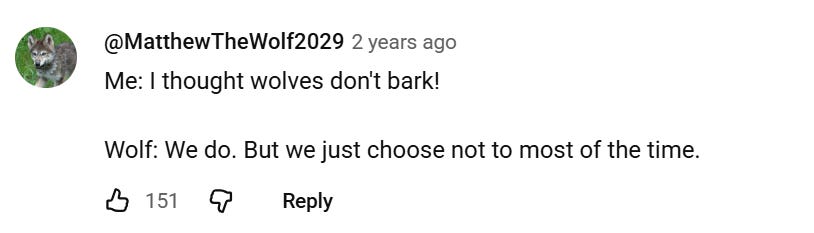
Early wolf researchers had never come across wolves barking, so they said wolves didn’t bark. It’s weird to think that wolf research is really only 50 years old in the White Westernised Male world. I’m sure all the people living around wolves (whose views are not classed as ‘research’, naturally) knew they barked. But because the researchers (mostly in planes, it must be said, or the odd bloke hiking for months on end) didn’t come across wolves barking, they just thought wolves didn’t. Or couldn’t.
One quick look at videos on YouTube will show you precisely where wolves bark: when small family members are reliant on staying put in a territory because they’re still growing and the parents are trying to dissuade a larger predator (usually people) to cease and desist their approach. In other words, when something’s keeping you in situ and you can’t leave, but you aren’t about to let Bob Grundy come through near your babies, barking might be a useful strategy. Of course, some wag will come along and tell you that this wolf clearly has a lot of dog admixture, as if all wolves don’t have dog genes to some degree or another. Maybe wolves bark more now than they did back in the times when dogs diverged from them, and it was reintroduced?
Who knows? Not me, for sure.
Younger wolves also tend to do it out of frustration, it seems. That fits with notions that dogs have retained many of the more puppyish behaviours of wolves. You can see the huff-wuff of the wolf and the howl, both of which feel very husky-ish to me.
I’m reminded of the fact that some of our first village dogs - late in the canine journey - will have had use in guarding property. I’m fascinated by Çatalhöyük in Turkey - one of the first permanent human settlements. Houses were built more like adjacent rooms with no alleyways between them. To get into them, you had to climb up to the rooftops, walk across the roof to your home and then descend through doors in the roof. There were dogs in Çatalhöyük - mostly interesting because of their fossilised shit these days - and their job seemed to be mainly eating human fecal matter, any stray butchery and probably keeping the humans alert to potential ne’er-do-wells and intruders. By the 4th millennium, guard dogs were pretty well-established across the Levant and into Africa. Their main tool was alerting the residents to potential intruders at night.
And this job they’ve continued throughout the next 6000 years - right up until the advent of burglar alarms, CCTV and other technological advances. I’m reminded that many burglars still say that dogs are the main reason they’ll give one property a miss and go to another, though I don’t know if this is just folklore or not.
So barking has served us, greatly.
It’s only become redundant in the last 50 years or so in some parts of the world.
In fact, in many parts, it’s still massively useful. Barking is a great way to let you know there’s an intruder, but also to deter the intruder completely. I’ve only been intruded upon once, and Heston did his very best shepherding. I was in some other part of the garden and I heard this very loud, very prolonged barking from Heston down at the bottom of the garden. I run down and he’s cornered some bloke who was absolutely wetting himself. Heston had a mighty, mighty bark. I don’t know many dogs whose bark rivalled his - long and deep and quite terrifying. My neighbours said, politely, that I was bien guardé. I was. Heston had pinned the guy in position like you see in protection sports in the blinds and was not about to let that guy set one step further into the home. Thankfully the man obliged and stayed put until I arrived, but I think he needed a strong cup of tea after that. Served him right, to be honest. No harm, no foul, but it was a good job he listened to that mighty barking. I’d still recognise the angered German shepherd bark anywhere. Heston might have only had a tiny bit of GSD in him, but he definitely got the German Bark and not the Belgian, because the Belgian bark is quite rubbish. Lidy’s barked three singular times this year and all of them have sounded quite pathetic. But it’s not her forte.
Anyway, I was thinking about all this when thinking about dogs who bark at us for interactions or to get us to do their bidding. I put together a post and a series of simple summaries as an overview on Facebook here. They kindly didn’t bother to share it with hardly anyone. 2960 followers and Facebook put it in front of 368 of them. What’s the effing point?!
My big aim next year is to be able to put posts like these into a bunch of things I can share off social media: a short, themed, magazine-style mini ebook; a long-form 20-30 minute video shared on whatever video platform takes my fancy; a printable infographic. That kind of thing. That way I’m not reliant on the vagaries and whims of social media giants obsessed with squeezing the last dollar out of small businesses that people have actually chosen to follow.
I’m really proud to be able to donate 20% of Lighten Up income to charities and associations working at a grassroots level, and I absolutely do not want to give that to Mark Zuckerberg or any other billionnaire.
I also know just how much modern social media punishes charities who won’t or don’t or can’t afford to have advertising campaigns.
It still drives me mad that the ‘Big Three’ dog charities in the UK average £7500 per rehomed animal (not just dogs, obviously) where the charities I work with are often trying to rehome animals with a budget of less than £1000 for vaccinations, sterilisations, food, lodging and the likes.
It’s not just fat cat salaries for the chief executives, but investments in rip-off for-profit companies like Omaze that play on the housing crisis and people’s desperation for a better life with lottery-style tickets where a relatively small proportion of the income goes to the charity. PS not everyone can get an Omaze-style representation - Omaze are very picky about which charities’ large social media platforms and mailing lists they’ll exploit. You would be, if you want to take 83% of the profit from donations, as Omaze do. No point representing small charities with small platforms. You want wholesale. You want big audiences. There are now a bunch of other for-profit businesses doing the same as Omaze: ‘let me take advantage of your huge platform to advertise a house, yacht or car for a raffle and we’ll give you a small chunk of change in return’. If you’re not big enough to be represented by Omaze, you can find one of the smaller sharks to raffle a house in your name so you can make a tiny proportion of the income. Omaze and others like Rafflehouse (‘Dream Big! Do Good!’ - gamble with a conscience!!) also invest a lot into advertising on social media platforms.
So much income from charities now goes directly to the Tech Gods as a result of the modern algorithms. Trying to get the attention of people who’ve chosen to follow you when you don’t want to or can’t spend money on paying to reach your audience is impossible, so small charities are even more starved as a result. Oh, and the cash that would have been perhaps donated to them now goes to bigger companies with the budget to advertise and thence, directly, to the pockets of the Tech Overlords.
I was chatting about this to a person who runs a Facebook group of 7500 individuals, attempting to rehome rottweilers. They often run small appeals for vet care, for transport costs, or for specialist diets and adjuncts for sick dogs. They’d got a really sad case recently which they’d shared profusely in their group and on their page, only to get 840 views. It really makes it feel like we lived in much easier times back in the mid 2010s when sharing animals, asking for donations, publicising events and whipping up a bit of community spirit. Living in France, a lot of that was done the old-fashioned way: we only got a proper website in around 2016 or so. Most of the small charities had noticeboard-style forums and not much more. At that time, 85% of adoptions happened through people just turning up at the shelter rather than because they’d seen a dog online.
It just makes me sad to see so much money that could be used productively at a grassroots level being funnelled upwards to the billionnaires and shareholders. I have no intention of contributing to that, ever. I already donate time to create such materials. If I worked out how much time I invested in creating materials shared on social media, it’s always 4 or 5 hours a week, and when I work out how much I cost per hour, I’m already donating a lot that keeps people on the platform. These platforms depend on high-quality content to keep people on them. Without it, we just drift right off. I’ve found myself spending very little time on social media this year other than TikTok because what’s served up is so shit. YouTube takes me down into a chaos of right-wing freakery within about five or six videos, so I only use it to search for specific people and their content or to view channels I subscribe to. Instagram - I can’t even! Facebook has periods where it’s 50% content I haven’t chosen to follow and I just scroll off without even getting past the first post.
Back in October, I did a bit of an experiment with Facebook. It was quite revealing. Firstly, it told me what I already knew: my audience like a single photo & text, not video or reels which Facebook had been chiding me to produce all year. Secondly, it told me that Facebook massively promotes content that’s hate-filled, click-baity, rage-baity. It also taught me that non-followers will come in droves to your page to tell you you’re wrong if you dare do anything they disapprove of.
None of this was anything I didn’t already feel in my bones. What it did, though, was tell me that I can appeal to anger (not the point of LIGHTEN up!) or attract a bunch of people who’ll never contribute or get involved with any of the free stuff I put out - let alone courses. Neither of these are things I want.
As I reshape into the latter end of the 2020s (how did that happen?!) I want desperately to do more of the ebook + longer-form video stuff, perhaps with the occasional short post or video thrown out on Facebook & Instagram. I’m not playing anymore and investing all that time for nothing. What’s the point? It benefits nobody, least not me.
I feel kind of sad about that. Social media had always been a good place for connection, for learning and for sharing. Now it just feels tawdry and mercenary. Nothing seems to be emerging to fill the void it’s left as we move into a highly monetised arena, and so that calls for different approaches. That’s fine with me. I’ve been through forums, MySpace and beyond. Maybe we’ll all end up with print copies of the Yellow Pages again. See, I’m old enough to remember when the best advertising was getting a listing in the Yellow Pages and if you wanted something, you just looked at what your town had to offer from a tiny list of phone numbers with the occasional tiny ad from the big spenders. If you were doing business-to-business, you just got a listing in a trade catalogue and the calls came in. That’s not to say there’s nothing wholesome out there. There’s such lovely stuff out there - it’s such a shame so much gets drowned in dross.
Anyway, that’s all why I’m waiting for the Fear course to finally move from ideas, research and notes into polished production all safely uploaded to Teachable. I’m desperate to get going with it all!
Back to the keyboard, slides, microphone and video! Just under 400 hours and counting!
PS have a marvellous, marvellous holiday season and please take care of yourselves, your dogs and your other loved ones. This time next week and we’ll be almost ready to turn the page into 2026! That feels mad!